

Secure Coding in Node.js: Engineering Exploit-Resilient Systems at Scale - I


Introduction: Security Failures in Modern Node.js Systems
In large-scale Node.js applications especially those operating in distributed architectures such as microservices, API gateways and serverless backends, security failures are almost never the result of a single isolated flaw. Instead, they emerge from compositional weaknesses, where individually safe-looking components interact in unsafe ways. These failures are systemic, not local.
Modern Node.js systems operate in a highly dynamic environment. They continuously ingest untrusted, high-entropy JSON payloads, often originating from browsers, mobile clients, third-party integrations or even other internal services that may themselves be compromised. The runtime model of Node.js is non-blocking I/O with a shared event loop which means that a single flawed execution path can impact the entire system’s availability and integrity.
The dependency ecosystem compounds the issue. A typical production Node.js service may include hundreds of transitive npm dependencies, many of which execute code during runtime initialization, manipulate prototypes or introduce implicit behaviors. This creates a scenario where developers are not just trusting their own code but delegating trust to an entire supply chain of unknown execution paths.
The critical issue is not lack of validation but it is misplaced trust boundaries. Data is often validated once and then implicitly trusted across multiple layers even though each layer may interpret that data differently. This leads to a fundamental breakdown that Security is not broken by bugs rather it is broken by assumptions.
Threat Modelling for Node.js Microservices
A typical production flow:

At a high level, this flow appears logically segmented but in reality, data flows through these layers with minimal re-evaluation. The API Gateway may enforce rate limiting and basic schema validation, but once the request enters the application boundary, it is often treated as safe.
Middleware layers frequently mutate request objects, adding user context, permissions or derived attributes. However, these mutations are rarely immutable or cryptographically verified. As a result, downstream services may rely on mutable state that originated from untrusted input, creating subtle attack vectors.
The service layer is particularly dangerous because it represents the business logic core where decisions with real-world impact are made like financial transactions, access control, or infrastructure operations. Developers often assume that by the time data reaches this layer, it has been sanitized. This assumption is precisely what attackers exploit.
The data access layer amplifies risk further. It translates application logic into database queries or external API calls. If untrusted data reaches this layer in a structured form, it can influence query semantics, execution plans or even control flow in external systems.
The critical failure here is not lack of validation but it is single-point validation. Attackers exploit this by injecting payloads that remain benign at the edge but become malicious when interpreted differently downstream.
Injection in Modern Data Layers (SQL + NoSQL + ORM Abuse)
Realistic Vulnerable Pattern (ORM Misuse)

At first glance, this appears safe because there is no raw SQL concatenation. However, the vulnerability lies in delegating query structure to user-controlled input. Modern ORMs like Prisma or Sequelize do not just accept values but they accept structured query objects that define operators, conditions and logical relationships.
When req.query is passed directly into the ORM, the application is effectively allowing the attacker to construct the query abstract syntax tree (AST). This is far more powerful than traditional injection because it bypasses string-based defences entirely.

This payload does not inject code; it redefines query semantics. Instead of filtering by a specific email, it transforms the query into a logical condition that matches nearly all records.
Why This Happens
The root cause is a misunderstanding of how ORMs operate internally. Developers assume that because ORMs abstract SQL, they inherently prevent injection. In reality, ORMs expose a higher-level query language and when user input is mapped directly into that language, it becomes a vector for logic injection rather than syntax injection.
Secure Pattern (Schema Enforcement)

The secure approach is not just type checking, it is semantic validation. Inputs must be reduced to a strict, minimal representation that aligns with business logic not database capabilities.
Injection today is not about breaking syntax, it is about controlling structure and meaning within abstraction layers.
Command Execution in Distributed Systems
Production Anti-Pattern

exec(`grep ERROR ${file}`)
This pattern is common in systems that interact with the OS,log analyzers, CI/CD pipelines, backup script or admin utilities. The vulnerability arises because shell commands are constructed using string interpolation, allowing user input to influence command parsing at the shell level.
Exploit

Here, the attacker does not just modify the argument but they break out of the intended command context and inject new commands. The shell interprets ; as a separator, executing multiple commands sequentially.
Impact
This is one of the most severe vulnerabilities because it bridges the gap between application logic and operating system control. Once exploited, attackers can execute arbitrary commands, exfiltrate sensitive files, pivot to other systems or establish persistence.
Secure Pattern

Using spawn eliminates shell interpretation entirely. Arguments are passed as discrete tokens, preventing injection at the parsing level.
Additional Controls
Even with safe execution methods, the environment must be hardened. File paths should be strictly validated, execution contexts should be sandboxed and processes should run with minimal privileges. Without these controls, even non-injection vulnerabilities can escalate into full compromise.
Prototype Pollution in Configuration Pipelines
Real Production Pattern

This pattern is ubiquitous in Node.js systems. Configuration merging is used everywhere like in feature flags, request options, caching strategies and access control decisions. However, JavaScript’s prototype system introduces a hidden risk: object inheritance can be manipulated globally.
Exploit

This payload modifies the base object prototype. As a result, every object in the application may inherit isInternal = true, depending on how objects are accessed.
Impact

The real danger is not the pollution itself but it is where the polluted property is used. If authorization logic relies on object properties without strict ownership checks, attackers can bypass security controls globally.
Secure Pattern

The safeMerge function is secure because it explicitly mitigates Prototype Pollution by blocking the keys proto, constructor and prototype. These specific properties are gateways to the JavaScript prototype chain; if an attacker can manipulate them, they can inject malicious properties into the base Object, affecting every object in the application.
By filtering these keys out during the merge process, the function ensures that only standard data is copied preventing unauthorized access to the object's internal inheritance structure.
Prototype pollution is a meta-level vulnerability; it does not attack logic directly but instead alters the environment in which logic executes.
Authentication & Token Mismanagement at Scale
Common Production Pattern
const token = jwt.sign(payload, process.env.JWT_SECRET);
JWT usage is widespread but misconfigurations are equally common. Tokens are often signed with weak secrets, lack expiration or are reused across services without proper scoping.
Risks
Tokens are effectively portable authentication artifacts. If compromised, they allow attackers to impersonate users without interacting with authentication systems.
Secure Pattern

Using asymmetric cryptography (RS256) separates signing and verification responsibilities, reducing risk in distributed systems. Short-lived tokens limit exposure, while claims like audience and issuer enforce contextual validation.
Advanced Controls
Real-world systems implement key rotation, token revocation lists and anomaly detection to identify misuse patterns.
File Upload Pipelines in Cloud Systems
Production Scenario

File uploads appear simple but are inherently dangerous because they introduce binary data into the system boundary. If improperly handled, files can become execution vectors.
Exploit
Uploading executable scripts disguised as legitimate files allows attackers to host malicious code within the application’s infrastructure.
Secure Pattern
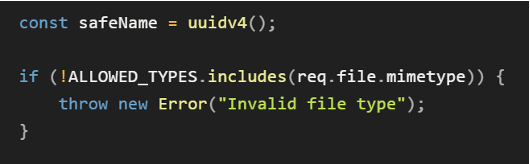
Security requires strict validation of file types, renaming to prevent path manipulation and storing files in non-executable contexts. Additional scanning ensures malicious payloads are detected before use.
Additional Controls
Signed URLs, isolated storage buckets and content delivery restrictions prevent unauthorized access and execution.
What's next?
Node.js enables rapid development but also rapid compromise when misused.
At scale, vulnerabilities are not isolated they are composable. Attackers chain them to escalate impact. The goal of secure coding is not to eliminate every bug because that is unrealistic. The goal is to ensure that no single vulnerability can cascade into system compromise.
More vulnerabilities and defense techniques will be added in next part of this blog. Stay Tuned.
Comments